
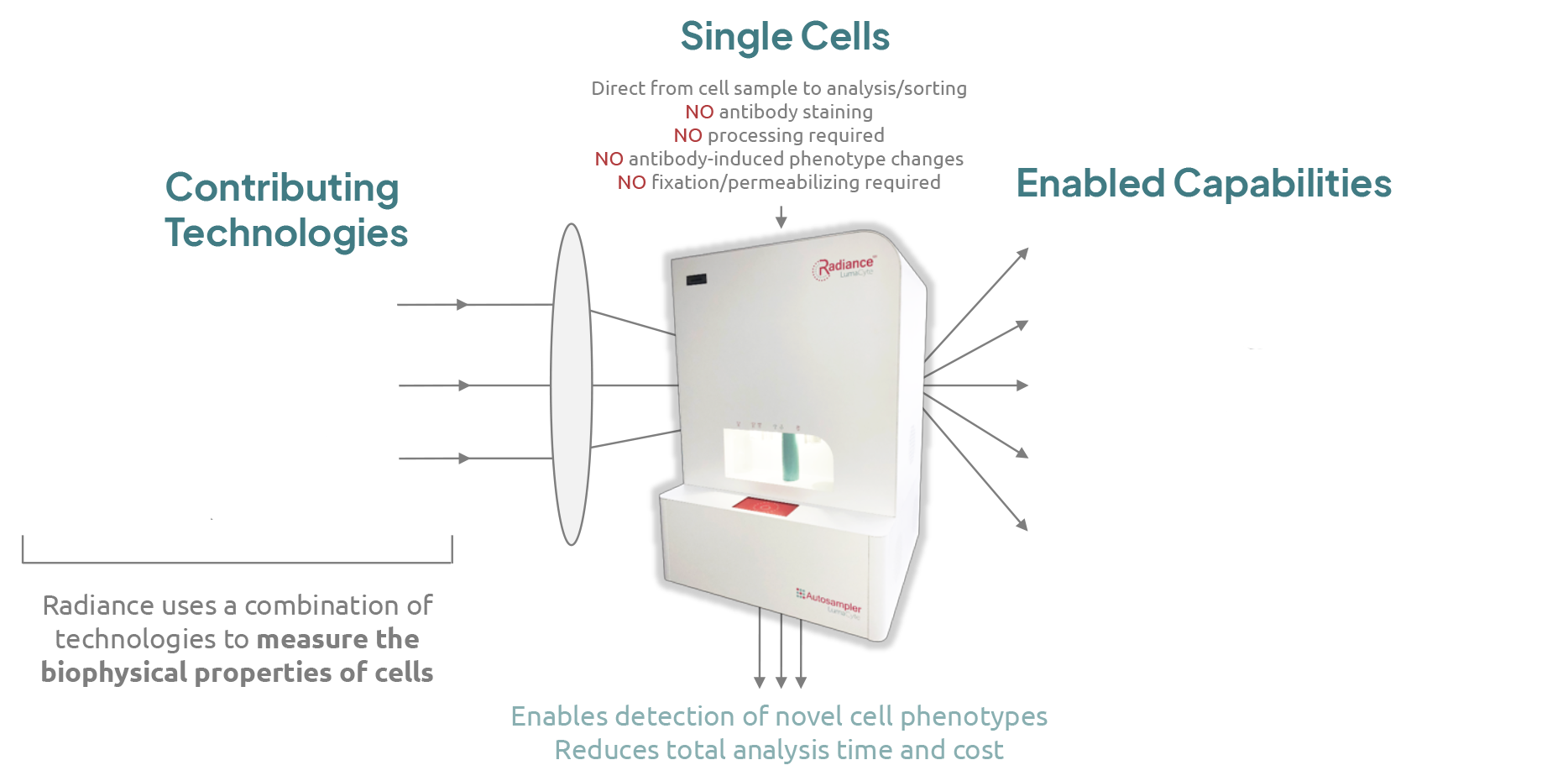
LumaCyte’s transformative microfluidic cell analysis technology, Laser Force Cytology™ (LFC), offers researchers and biomanufacturers a label-free single cell analysis capability where the use of antibodies or genetic labeling is not required. LumaCyte’s Radiance instrument uses a unique combination of advanced optics and microfluidics to automatically identify and characterize cells of interest based upon key intrinsic biophysical and biochemical cellular properties and dynamics. Laser Force Cytology (LFC) delivers a more robust and powerful sample analysis compared with conventional label-based flow cytometry.

Label-Free LFC™ Analysis

The biopharmaceutical world is evolving rapidly, bringing with it the need for innovative technologies to support this fast-paced and changing environment. LumaCyte’s advanced bioanalytics platform, Radiance®, is a label-free, single cell approach for quantitative characterization of innate cellular responses without the need for antibody or genetic labeling. This revolutionary technology utilizes Laser Force Cytology™ (LFC™) to measure cellular response and changes to their intrinsic biochemical and biophyscial properties by measuring optical and fluidic forces on cells in a microfluidic device. Subtle cellular changes can be precisely captured with Radiance’s automated workflow, allowing developers to measure real-time product quality attributes and immediately optimize processes, significantly improving both production quality and product yields. This includes both in-process analytics to inform and optimize the production process as well as offline release and potency assays used to ensure product quality and consistency.

LFC detects subtle phenotypic changes in cells, rapidly measuring quantitative early indicators of cellular response including viral infection, transfection and differentiation.

Label-free Single Cell Analysis Provides Solutions

Subtle cellular changes can be precisely captured with LumaCyte’s Laser Force Cytology™ platform, allowing developers to measure real-time product quality attributes and rapidly optimize processes, significantly improving production quality, yields and shelf life.

  • Label-free single cell analytics reduce the need for antibodies, provide unbiased measurements and enable the discovery of novel cellular changes
  • Accurate, precise and non-subjective cell-based analytics comprehensively characterize complex raw materials and products in a novel way
  • Real-time analytics increase process knowledge, enable improved process control and optimization, and maximize resource efficiency
  • Reduced labor and waste, improves yields, significantly lowering costs and accelerates time to patient

Advanced bioanalytics are becoming a vital component of a successful Quality by Design (QbD) biomanufacturing program, where accurate and precise real-time data hold the keys to improved production consistency and product quality. LumaCyte’s label-free single-cell analysis platform, Radiance®, using Laser Force Cytology™ (LFC™), delivers advanced analytics for real-time bioprocess monitoring and quality control strategies.

https://www.youtube.com/watch?v=J4559asAUc0

LumaCyte Force Cytology

1:31 duration

Subtle cellular changes can be precisely captured with LumaCyte’s Laser Force Cytology™ platform, allowing developers to measure real-time product quality attributes and rapidly optimize processes, significantly improving production quality, yields and shelf life.

  • An optical force is generated when a laser beam reflects and refracts through a cell
  • Laser Force Cytology measures velocity (optical force) and other parameters to detect subtle phenotypic changes in cells, rapidly measuring quantitative early indicators of cellular response to viral infection, transfection and differentiation
  • Applications in, cell and gene therapy and vaccine development and biomanufacturing
Microfluidics

Hydrodynamic focusing

Optical Tweezers

Photon pressure

Image Capture

Digital imaging, storage, processing, pattern recognition

Analvze Untreated Cells

Minimal reagent costs

Unbiases Biophysical Measurements

Novel physical properties

Phenotype New Cells

Discover Unknown Unknowns

Detect New Cell States

Infection, cancer, differentiation

Probe Cell Deformability

Factors Affecting Optical Force

Laser Force Cytology (LFC) is a label-free, microfluidic cell analysis and sorting technology where the use of antibody or genetic labeling is not required for cellular analysis. Subtle phenotypic changes in cell biochemistry and morphology (cytoskeletal changes)[4], which are often associated with cancer, sepsis, and other diseases, give rise to detectable differences in optical force, deformability and a host of other multi-variate data parameters quantitated by Radiance™.

Shape
Surface morphology,
coatings
Refractive index (proteins,
cytoplasm, membrane)
Internal cellular structure
and organization

Laser Force Cytology™ Parameters

Optical Force – D cell velocity (mm/s)

Rate of Change of Optical Force – D cell acceleration (mm/s2)

Optical Force Index (s-1)
This parameter is optical force independent of cell size

Cell Focal Position (pixels)
Cell Focal Position is the X-pixel (horizontal) position at which the minimum velocity occurs.

Optical Angle (0 to 180 degrees)
Rotational position of cells relative to the horizontal beam

Major Axis Deformability (Ratio, dimensionless)
Major axis deformability is the ratio of the major axis with and without forces applied, which changes due to the cell being pinched between optical and fluid forces

Eccentricity (Ratio from 0 to 1, dimensionless)

Eccentricity is a measure

Comparison of LFC and Flow Cytometry

Close Menu